
Client: Blink Ops, security automation for SOC and IR teams. Engagement: A blog programme that grew from a small baseline into a steady publishing cadence across integrations, incident-response workflows, and adjacent GRC topics. Our role: Cyberou produced publish-ready drafts in Blink’s voice - structured like product documentation so practitioners could follow the work in a real console.
Summary
Early-stage security platforms often ship fast while their blog still reads like a placeholder. Blink Ops needed a library of posts that analysts would actually use: integration walkthroughs (including with partners like ThreatQuotient), IR patterns, and governance topics that connect to how teams run operations day to day.
The programme delivered thirty-nine publish-ready posts in this chapter of the work, written with analysts first and SEO second. Blink’s team attributed a double-digit quarterly traffic lift to the programme in internal reporting (organic discovery compounding as the archive grew).
- Concrete automation patterns, not vague “AI SOC” essays
- Partner-aware integration content that could support co-marketing
- Editorial consistency across many authors’ worth of volume
Challenge
SOC automation content fails when it stays at slogan level. Blink’s readers are trying to solve boring Tuesday problems: parse alerts faster, reduce toil, wire tools together without creating new failure modes. The writing had to respect that reality.
SEO mattered, but not at the cost of trust. If a post read like it was written for a crawler first, practitioners would bounce and the programme would not compound.
Volume without a system creates drift: five posts that sound like five different companies. Blink needed a repeatable drafting and review rhythm that could scale without turning the blog into chaos.
Approach
We outlined each piece like internal runbook documentation: prerequisites, steps, expected outcomes, and where Blink fits without turning every paragraph into a product pitch. Drafts went through Blink review for technical accuracy and positioning.
For integration posts, we prioritised sequences a reader could reproduce: what to click, what to connect, what breaks when you do it wrong. That is the bar practitioners use when they decide whether to bookmark a vendor blog.
Across the archive, we reused narrative scaffolding so Blink’s voice stayed stable: plain titles, tight intros, and sections that answer “what do I do next?” early enough to respect busy readers.
Results
Blink Ops gained an organic surface area that could support outbound, onboarding, and partner motions: a growing set of URLs that explain real workflows instead of repeating the homepage promise in different fonts.
The headline quantitative signal Blink shared in programme reporting was organic growth: a double-digit quarterly lift attributed to the blog work, consistent with what happens when practitioner-intent search meets useful pages.
Qualitatively, Blink’s marketing lead described the collaboration as a force multiplier for a very small team (see Cyberou platform testimonials), which is the operational outcome we design for when a client cannot afford a full in-house newsroom.
Published work
- 5 Powerful Automations You Can Build with BlinkOps + ThreatQuotient · Blink Ops blog
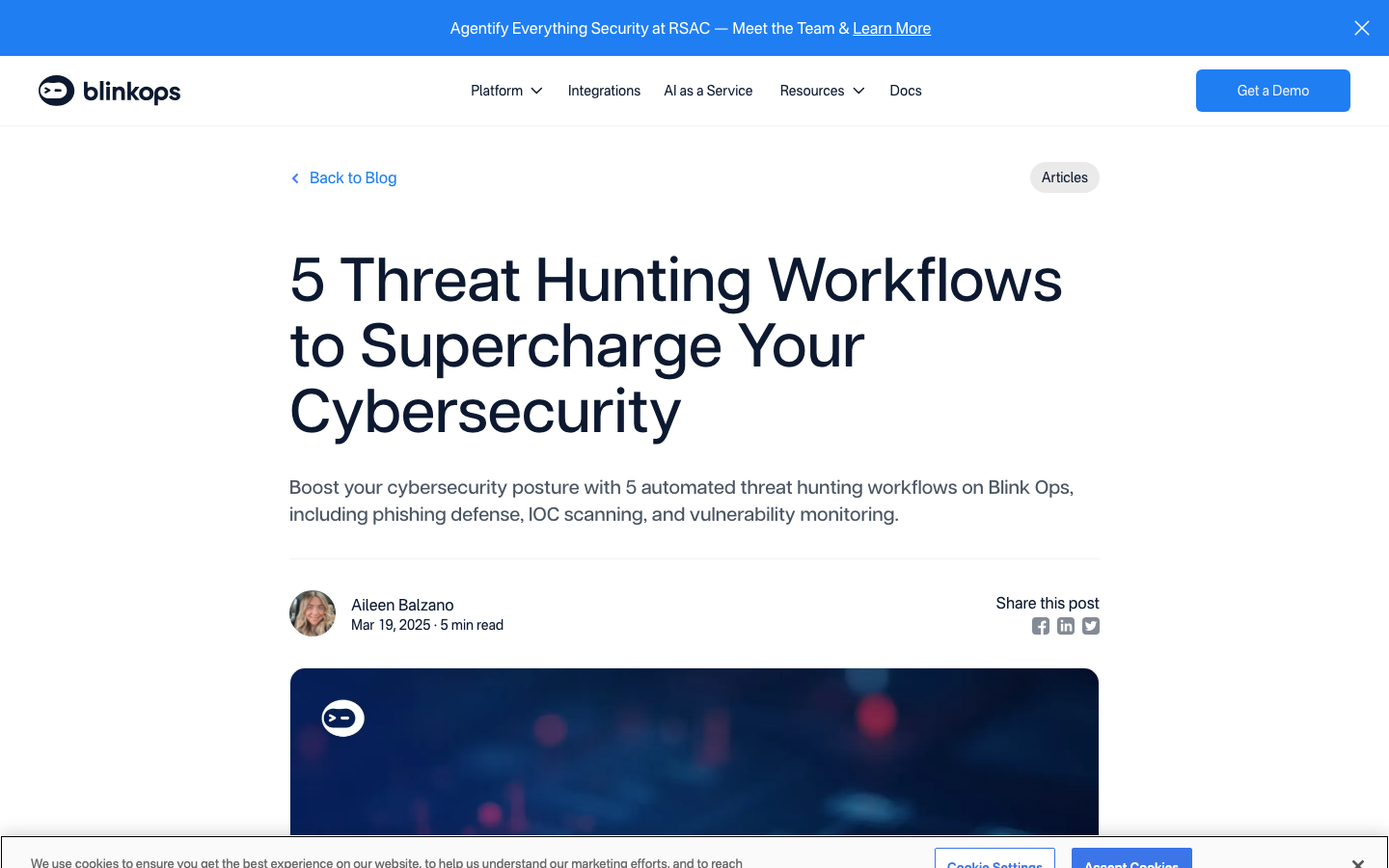
- 5 Threat Hunting Workflows to Supercharge Your Cybersecurity · Blink Ops blog
- 5 Automated Workflows to Enforce Security Basics Across Your Organization · Blink Ops blog
- Examples of work · full live-link catalogue